Panama’s Political Landscape and Some History Since the Noriega Years
Last Updated on September 23, 2025 by Retire in Panama
Forty years ago, Panama was quite a different country, but to explain this, I will need to go back a few years before that. A military dictator, Manuel Antonio Noriega Moreno, was the de facto ruler of Panama from 1983 to 1989. Not many expats were living here at that time. The economy was stagnant, the poverty rate was well over 40%, and the people were scared to be outside of their homes. It was a different Panama.

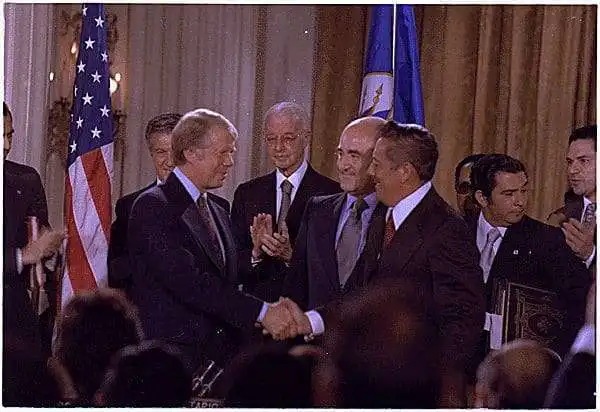
The 20 years before this time, Panama politics were a real mess, the one major win for the Panamanian people, was the 1977 Torrijos–Carter Treaties which would had over the Panama Canal back to Panama control in 1999. President Torrijos died in a suspicious plane crash in Panama on August 1, 1981, suspected but never proven to be an assassination. His death altered the tone, but not the direction of Panama’s political evolution. At this time, the PRD (Panama Defense Forces) dominated Panama’s political arena, and General Noriega was firmly in control of the PDF and the civilian government.
Rather than becoming president and the public scrutiny that came with that position, Noriega chose to remain behind the scenes. Noriega convinced the Panamanian Congress to pass Law 20, which aimed to protect the Panama Canal from communists and allowed a significant influx of US weapons into Panama’s military. The law also tripled the size of the Panama army, which Noriega was in control of.
In May 1984, Noriega permitted the first presidential elections in 16 years, and he selected Nicolás Ardito Barletta Vallarino as the PDR’s candidate, whom he could keep under his control. When the initial election results started coming in, it seemed the opposition was winning by a landslide, so Noriega halted the count, manipulated the election, and it was announced that the PRD had won by a slim margin. Noriega ran the country in a very repressive manner with President Barletta as his puppet.

This very short history brings us to the time in late 1989 when relations with Panama, Noriega, and the US government were not going well, and the US invaded Panama on December 20th, and ousted Noriega, who would hide, but later surrendered on January 3rd, 1990. Noriega would spend the rest of his life in jail in the USA, then in France for money laundering, and finally, he was extradited to Panama in 2011 to face trial there. Noriega died in Prison in Panama on May 29th, 2017.
The day after the invasion, Guillermo Endara was sworn in as the President. He was the leader of the main opposition party to Noriega’s rule. Within 2 months, he abolished the Panamanian military and replaced it with a national police force. Since then, Panama has held free and democratic elections every five years.
Now that we have reviewed the period in Panama, we will discuss the government structure in place in Panama. The government consists of three parts: the Executive branch, the Legislative branch, and the Judicial branch.

Executive Branch
The Executive Branch consists of the President, Vice President, and the President’s appointed cabinet, known as State Ministers. The president and vice president are elected on a single ballot for a 5-year term by a direct popular vote. The President is limited to two terms, but not consecutive, and may run again after waiting. Panama elects a new president every five years, although they may represent the same political party.
Legislative Branch
The legislative branch has a unicameral (one house) National Assembly, consisting of 71 elected members, with 5-year terms, from single to multi-seat constituencies.
Judiciary Branch
 Elections in Panama
Elections for Federal, Provincial, and Municipal are held every 5 years. An autonomous Electoral Tribunal supervises voter registration, the election process, and all activities of the political parties. Everyone over the age of 18 is required to vote, although no one has ever been prosecuted for not voting.
We recently went through the election process in Panama, and I paid very close attention to it this year, given all that is happening back in my home country and in the USA with politics. I found it very interesting. You hear basically nothing about the election until about 60 days before the date, when the signs start popping up for the political candidates. Then, 60 days before you hear and see the ads on the Radio and TV. I found that very refreshing, after two years of listening to political campaigning back home.
The elections are always held on a Sunday. For two days before the election, no alcohol is sold or served. I guess they want the voters to have clear heads at the polls:) . On Sunday, election day, there is a lot of activity around town and cities, with people heading to the polls to vote. Then, family and friends gather in a backyard BBQ-type setting for parties.
In Panama, who gets to vote, and who does not is quite simple, all Panama Citizens have national ID cards called Cedulas, you go to your voting station, show your Cedula and vote, simple. Permanent residents who also have E-Cedulas cannot vote, only citizens.
Political Parties in Panama
In past elections, four main parties have been running. On May 5, 2024, election day in Panama, José Raúl Mulino was elected as Panama’s new President-Elect. He assumed office in July 2024. Mulino ran as leader of the political party Realizando Metas (Realizing Goals). He received 34.4% of the vote, with the closest competitor, Ricardo Lombana, receiving 24.8% of the vote. The voter turnout was 77.6%.
In this political system, the President and the elected party do not necessarily have the majority of the popular vote. In fact, this year, the President-elect, José Raúl Mulino, of the Realizando Metas, had 34.4% of the popular vote. So coalitions must be made in the Assembly (House) to pass any laws.
What I found most interesting about the four main parties and their issues was that, in my opinion, all parties were center-right. There was no extreme division between left and right ideologies; instead, there were different opinions on how to grow Panama’s economy and how to care for its citizens.
Since the ousting of Manuel Noriega in 1989 and the first appointed President in 1994, Panama has held fair, peaceful, and uncontested elections every five years.
Panama elected its first woman president, Mireya Moscoso, who served from 1999 to 2004. In a recent presidential term, a woman, Isabel Saint Malo, served as vice president.
Although Panama’s recent election process appears to be satisfactory, its politicians may not be as effective. There has been considerable corruption in Panama’s politics over the years. However, it seems to be getting better, with candidates running on platforms to rid the government of corruption.
Panama is a peaceful, stable democracy and an economically growing country, making it an excellent place to spend your retirement years or establish a business. Take one of our Retire in Panama Tours, to find out if it is right for you.