The Economy of Panama Today (2026): Growth, Challenges, and Opportunities
Last Updated on March 15, 2026 by Retire in Panama
 1. Introduction
Although Panama is one of the smallest countries in Latin America, it has significant regional importance. Due to its location between the two Americas, the country has become an important center for international trade, logistics, and financial services. Without counting the services provided by the Canal, Panama is considered a major center for sophisticated service activities in the region. The Colon Free Trade Zone, the largest free zone in the western hemisphere, has established itself as one of the most important centers for the redistribution of goods throughout the Americas.
The use of the US dollar, alongside Panama’s currency, the Balboa, has also contributed to the country’s economic importance in the region and has provided economic stability in contrast with other Latin American economies.
What makes Panama’s economy unique and resilient is its export-less model, based mostly on services and logistics. This economic structure has allowed the country to continue growing and maintain economic stability in unlike other Latin American nations.
Panama has one of the most service-based economies in Latin America, with a far greater reliance on services than on agriculture or industry. Financial services are based in the capital, and commercial trade is centered in the Colón Free Trade Zone, all of which contribute to Panama’s status as one of the most important centers of commerce and finance in Latin America.
2. Historical Context: How Panama Built Its Modern Economy
The modern economy of Panama was built on its strategic geographic position. The economy was bolstered by the Panama Canal, completed in 1914. Since then, the Panama Canal has become one of the world’s busiest shipping lanes and has generated substantial revenue for the Panamanian government. Additionally, the Panama Canal has fostered the growth of international ports, logistics, and freight companies throughout the country.
The service-based economy is also reliant on international banking, finance, and commerce. In 1948, the government established the Colon Free Trade Zone, which is now one of the largest free trade zones in the world. This free trade zone has established Panama as a major commercial and trading hub. Panama is also a major international banking centre due to its financial laws and the government’s allowance of the United States Dollar alongside its local currency. Many multinational companies have regional headquarters located in Panama.
Over the past twenty years, Panama has experienced a surge in massive infrastructure projects, tourism, and real estate development. In 2016, the Panama Canal expansion was completed, increasing the canal’s capacity to accommodate even larger “Neopanamax” ships. This, in conjunction with investment in port facilities, airports, highways, hospitals, and logistics parks, has established Panama as a regional business and transportation hub.
3. Key Economic Indicators in 2026
The World Bank has forecast that Panama’s economy will grow by 4.1% in 2026 and 2027, nearly double the regional average of between 2.3% and 2.6%. This growth will be largely due to logistics (Canal de Panamá), trade, and tourism. Source.
Previous forecasts for 2024 and 2025 indicated that the economy would grow between 2.4% and 3%, driven by diversification and private-sector employment, but Panama surpassed those figures. Some analysts even expect higher growth in 2026. Panama is poised to lead regional economic growth in 2026, according to projections by Mens Consultores. The country’s GDP is expected to expand by 5.57%, driven by the Panama Canal, the mining sector, and logistics. Source.
 4. Inflation and Monetary Stability
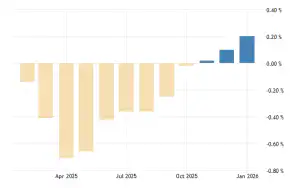
The inflation rate in Panama in 2026 will be very low. According to the IMF, the average consumer price will rise by 2 percent in 2026. After a period of low to negative inflation in the last months of 2025, inflation in January 2026 was 0.2 percent on a month-to-month basis. Source.
Main Key Inflation and Economic Projections for 2026
Inflation rate: Average inflation rate expected to remain at 2 percent. In early 2026, inflation showed a slight month-to-month increase, registering 0.2 percent in January.
Economic indicators: Heavy investment in infrastructure. Panama is planning to invest 11 billion in major projects, such as the Metro Line 3 and the fourth bridge over the canal.
Unemployment rate: 7.7 percent in 2026.
General government gross debt:
60.3 percent of GDP in 2026. You can check out this IMF chart to see how other countries compare in terms of their debt-to-GDP ratios.
Let’s get personal on inflation.
Panama’s inflation rate over the last 20 years has averaged below 2%. In 2025, we actually saw negative inflation. The Trading Economics website has a good analysis of the 10-year inflation rate in Panama here.
Comparisons:
Over the last 10 years (roughly from early 2016 to early 2026), the United States has experienced a cumulative inflation rate of approximately 35.5%. Source.
Canada has experienced a cumulative inflation rate of approximately 39% over the last 10 years (roughly 2015–2025). Source.
The cost of living is one of the biggest factors why people are looking to move to Panama. The average monthly Social Security check for all retired workers in the US is expected to be around $2,071 in 2026. Source.
The Social Security benefit for a retired worker in 2016 was approximately $1,341. Source. That’s a 50% increase in Social Security Benefits for a retired US person, where inflation in Panama in those same 10 years has increased by only 20%.
So, yes, you can live more affordably in Panama if you are careful with the following.
You have to consider how inflation rates are calculated in other countries. It is not calculated based on your living and buying habits back in your home country. It is calculated in Panama based on how Panamanians live.
Here are some examples:
- 10 years ago, you could buy 10 bananas for $1; now you can buy 8 for $1, which is a 20% increase.
- A dozen grocery-store eggs cost $1.90; now they cost $2.25.
- One of my favorites, chicken wings, $1.10 per pound, now $1.30.
- 10 years ago, the house I was renting was $500 a month; it now rents for $600.
- The exchange of a 25 lb gas (propane) tank was $5.17, and now, it is $5.37.
- The price per kilowatt-hour of electricity for the first 300 kWh was 16 cents, and it still is today.
If you purchase locally made (Central America Region), you will find them more affordable than North American products. In the picture below, taken last week in a Panama Grocery store, you see Kellogg’s Brand Corn Flakes, 500 grams, for $4.05, where the local brand, Gran Dia, is $2.61 for 620 grams. Based on the box size, that is almost 1/2 price.

Driving through Chiriqui province, you will see vegetable sellers on the side of the road selling bags of vegetables for $7, up from $6 ten years ago. (2% a year inflation)

What has gone up in price over the 20% 10-year inflation?
Virtually all US-imported products. Not only have they increased the 40% inflation rate that the US has seen in 10 years, but there is also freight to get them here, and possibly now even additional duties on the US end if imported.
High-end real estate and rentals have increased more than 20% in the last 10 years. This is mainly because of supply and demand. As more expats with bigger budgets move here, they are willing to pay more for their homes, which drives up the high-end market.
The majority of expats moving here are on a budget, and the budget market in housing is still very affordable. You can find apartments and condos in Panama City and on the beaches at the same rental or purchase price as they were 10 years ago.
Also, throughout Panama, you will find new developer housing suitable for expats, with projects starting in the $120,000 to $175,000 range for 2-bedroom, 2-bathroom homes.
5. Conclusion:
Panama’s economy in 2026 continues to stand out in Latin America due to its strong service-based model and strategic geographic position. The country has developed into a major regional hub for trade, logistics, and finance, largely supported by the Panama Canal and the Colón Free Trade Zone, the largest free trade zone in the Western Hemisphere. Panama’s use of the U.S. dollar alongside the balboa has also contributed to economic stability and investor confidence. Over decades, investments in infrastructure, ports, airports, and the 2016 canal expansion have strengthened the country’s position as a global transportation and logistics hub, while banking and international commerce continue to play central roles in the economy.
Economic projections for 2026 remain positive, with growth expected to exceed the regional average due to strong activity in logistics, trade, tourism, and infrastructure development. Inflation remains relatively low at around 2%, and the government continues to invest heavily in major projects, including the metro expansion and new transportation infrastructure. Panama’s cost of living has increased moderately over the past decade. Still, it remains relatively affordable compared with countries like the United States and Canada, particularly for housing and everyday local goods. While imported goods and high-end real estate have risen in price, the broader housing market and many local living expenses remain affordable, contributing to Panama’s ongoing appeal to both investors and expatriates.
Oscar, Megan, & Rod
Retire in Panama Tours
Helping You Call Panama Home!






Nice post…very informative. Viva Panama!